A lawn that's yellowing, mossy or seems to be "suffocating" despite regular mowing? Often, the problem lies not with watering or fertilizing, but with an invisible layer that settles on the surface: thatch. The solution is lawn scarification. It's a simple, if somewhat spectacular, gesture, but it's highly effective in restoring life and density to your lawn.
So, when should you scarify your lawn, how should you use a lawn scarifier, and what should you do afterwards? Here's a step-by-step guide.
Scarifying your lawn: what's the point?
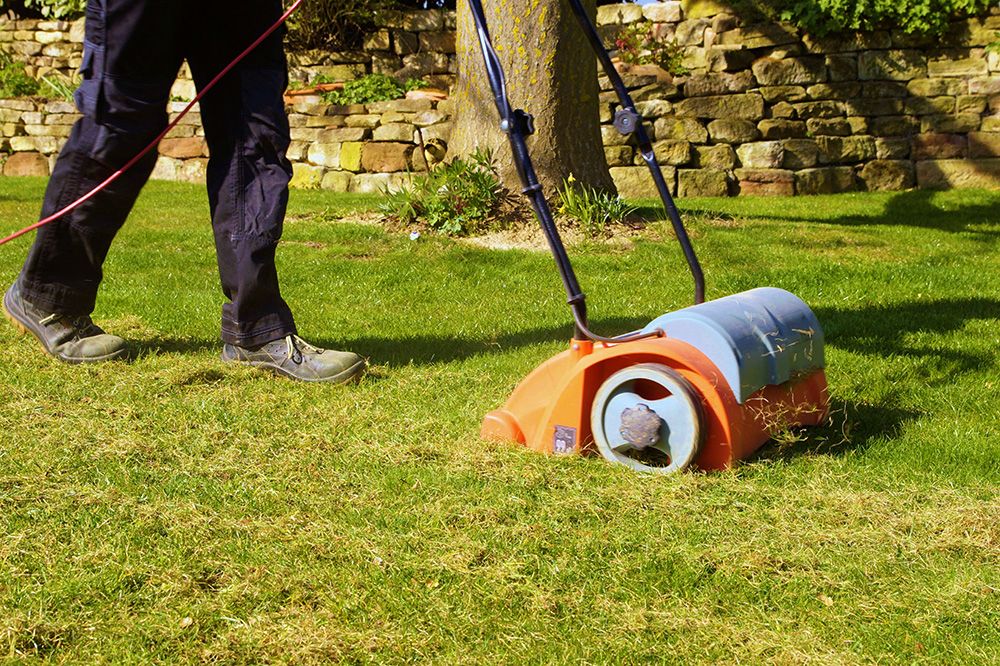
Scarifying means making fine incisions in the top few millimeters of soil to:
- remove moss,
- remove thatch (thatch, dead roots, grass clippings),
- improve air and water circulation,
- stimulate root development.
Over time, with repeated mowing, trampling and humidity, this thatch acts as a cover. The result: water penetrates poorly, roots breathe less, the lawn yellows and becomes lighter.
Scarifying your lawn helps it breathe again.
When should you scarify? The right timing makes all the difference
The question comes up again and again: when should you scarify your lawn?
The golden rule: intervene during the lawn's growth period, never in the midst of climatic stress.
In spring (March-April)
- After the last frosts.
- When the soil reaches around 10°C.
- Before or just after the first mowing.
This is the ideal time to revive the growth dynamic.
In autumn (September-October)
- After hot weather.
- Before the first frosts.
- When the soil is still warm and slightly damp.
Autumn is perfect for strengthening the lawn before winter and limiting the proliferation of moss.
To avoid:
- periods of intense drought,
- soaking wet ground,
- periods of frost.
Should the lawn be mowed before scarifying?
Yes, systematically.
Before using the scarifier on the lawn, mow short (2 to 3 cm). This allows the blades to penetrate the soil surface properly.
Collect the clippings: a clean lawn guarantees effective scarification.
To find out more about choosing your mowing equipment:
Lawn scarifier: manual, electric or thermal?
The choice depends essentially on the surface area.
Manual scarifier
- Ideal up to 100-200 m².
- Quiet and ecological.
- More physical, but sufficient if felting is light.
Electric scarifier
- Suitable up to 600-800 m².
- Handy and lightweight.
- Perfect for regular maintenance.
Thermal scarifier
- For large surfaces or difficult terrain.
- More powerful.
- Requires more maintenance.
For occasional use, rental is often the best solution:
How to scarify a lawn properly?
Here's the simple method for scarifying lawns properly.
1. Check soil moisture
It should be slightly damp. Too dry and the blades won't penetrate properly. Too wet and you'll pull out the roots.
2. Set the depth
Between 2 and 4 mm maximum.
Any deeper and you risk damaging the root system.
3. Mow in straight lines
As for mowing:
- first pass lengthwise,
- second pass crosswise.
Crossing improves scarification efficiency.
4. Pick up the waste
There will be a lot of moss and residue. Use a rake or empty the bin if your lawn scarifier has one.
This waste can be composted:
👉 What to do with green garden waste?
What to do after lawn scarification?
Your lawn will look sparse. This is normal.
Now is the time for the work to bear fruit.
Overseeding
If certain areas are bare:
- sow an overseeding lawn,
- rake lightly,
- water lightly.
Fertilizing
After scarification, the soil absorbs nutrients better.
- In spring: nitrogen-rich fertilizer.
- In autumn: potassium-rich fertilizer.
Watering
Maintain regular humidity for the next 10 to 15 days if the weather is dry.
To find out more about soil preparation and health:
👉 Preparing the soil before planting
And to think globally about garden equipment:
👉 Equipment for large gardens: the checklist
Scarification vs aeration: what's the difference?
Scarification works on the surface (2-4 mm).
Aeration penetrates deeper.
Scarification removes moss and thatch.
Aeration decompacts deeper layers.
The two procedures are complementary, but scarification is the priority if your lawn is mossy or yellowing.
Common mistakes to avoid
- Scarify a lawn that's too young (wait 2 to 3 years).
- Multiply scarification operations (maximum two per year).
- Set the machine too deep.
- Forget to collect the clippings.
- Scarify in the middle of a heatwave.
Scarifying your lawn can seem impressive the first time. The lawn looks damaged, almost assaulted. In reality, you've just given it back air, space and the ideal conditions to grow denser.
Twice a year, at the right time, with the right setting... and your lawn really changes its face.